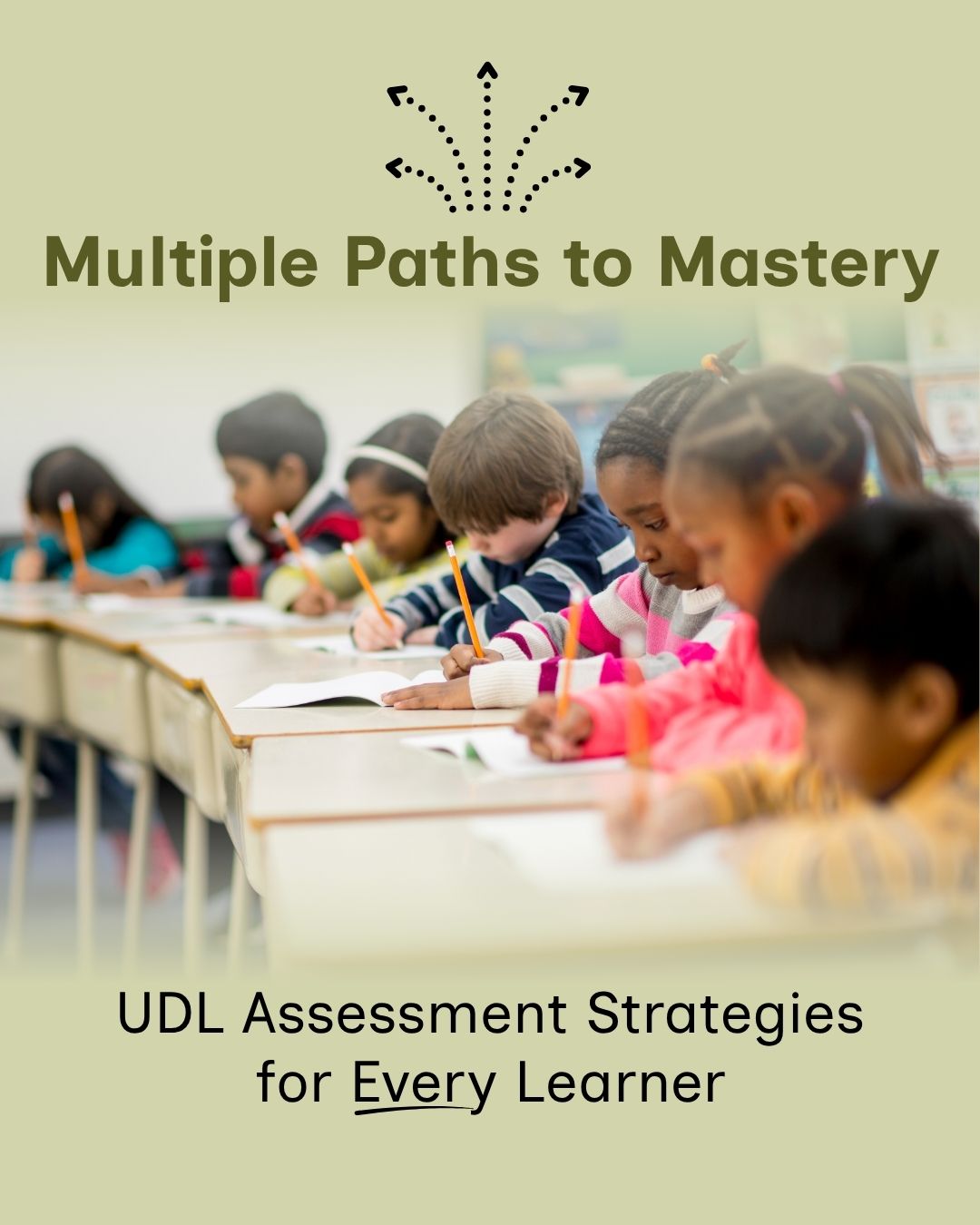
Multiple Paths to Mastery: UDL Assessment Strategies for Every Learner
As educational leaders and teachers, your ultimate measure of success lies in what your students learn and how they apply that knowledge. Student learning outcomes are a required metric, and they also guide your instructional choices toward meaningful learning for all students.
Learning outcomes clearly define what a student should know, understand, or be able to do by the end of a course, grade level, or program. They shift the focus from merely teaching content to ensuring observable and measurable mastery of that content.
When outcomes are clear, they support educators in designing effective instruction and assessment, and they help students understand the learning goal. Universal Design for Learning (UDL) assessment strategies build on that clarity by giving teachers practical ways to measure genuine learning without requiring every student to demonstrate it in the same format.
The Challenge of One-Size-Fits-All Assessment
Your classrooms are filled with creative thinkers, students with various levels of support needs, and students who think “outside the box.” Students come with varying backgrounds, strengths, and challenges, including those with unique learning needs or who are neurodivergent (for example, students with ADHD, dyslexia, or autism).
Expecting every student to demonstrate mastery in the exact same way, whether that’s a standard five-paragraph essay or a timed multiple-choice test, often measures their ability to perform under specific constraints rather than their true understanding.
This restrictive approach can obscure genuine learning. It leads to inaccurate assessment data and, most critically, poorer learning outcomes for a significant portion of our student population.
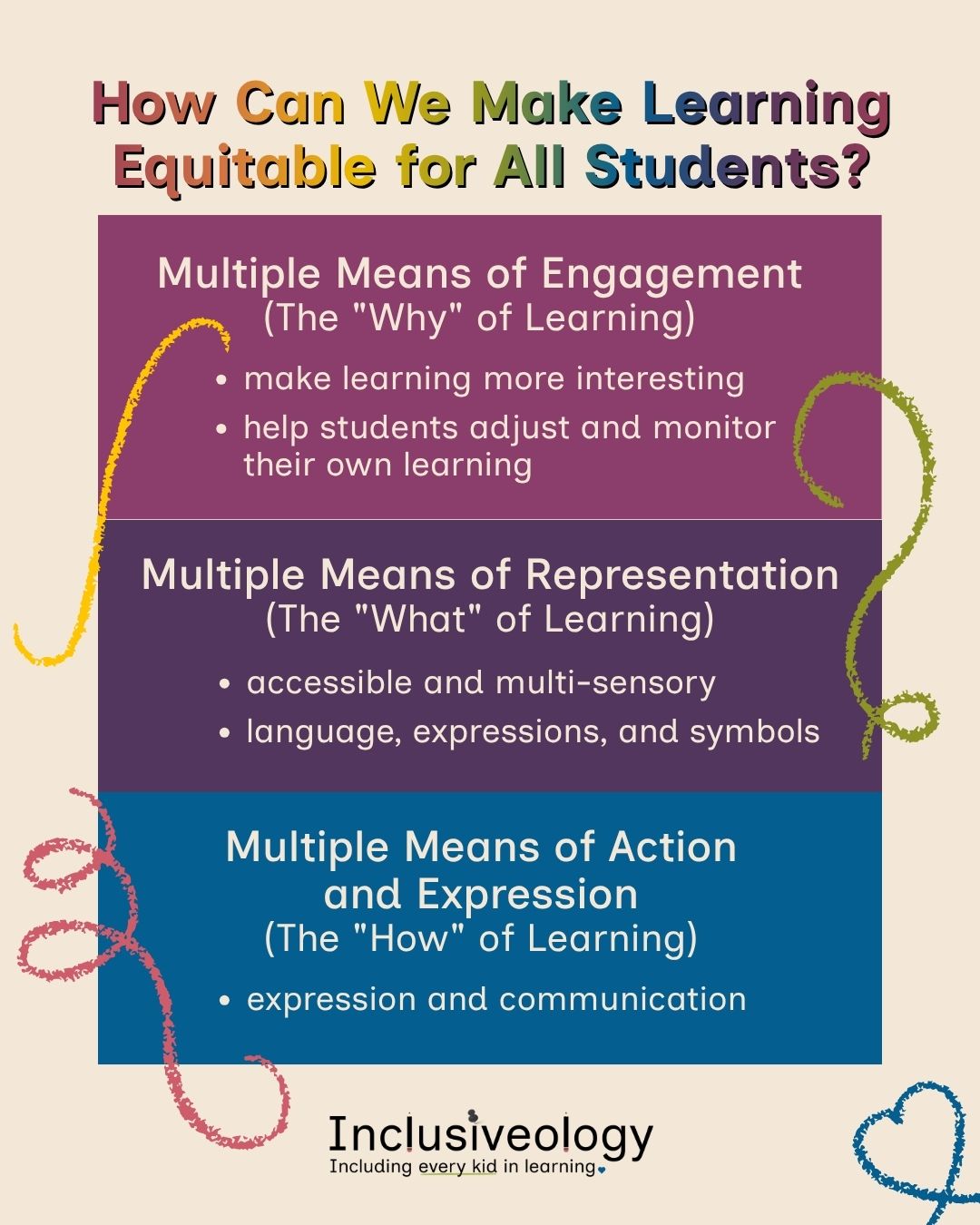
How Can We Make Learning Equitable for All Students?
Universal Design for Learning (UDL) offers a foundation for creating learning opportunities that meet the needs of all your students. UDL, a framework developed by CAST, guides the design of learning environments to be accessible and engaging for all. It anticipates learner variability from the outset and helps create instruction that works better for everyone.
UDL is structured around three core principles, each providing multiple options for how students can interact with content, directly supporting enhanced learning outcomes and the demonstration of mastery. Let’s take a look.
Multiple Means of Engagement (The “Why” of Learning)
This principle focuses on the affective network, the emotional component of learning. To improve engagement and motivation, UDL suggests offering choices:
- Offer options to make learning more interesting: Let students choose topics or tools for a project, connect learning to their personal lives, or work in groups or independently.
- Offer options to help students adjust and monitor their own learning: Provide clear rubrics, varied levels of challenge, and opportunities for self-reflection and goal-setting.
Multiple Means of Representation (The “What” of Learning)
This principle addresses the recognition network, or how students gather and categorize information. It ensures content is presented in ways that are accessible to all learners:
- Offer options that are accessible and multi-sensory: Provide text paired with audio narration, use visual aids, offer adjustable font sizes, and ensure all media is captioned.
- Offer options for language, expressions, and symbols: Define domain-specific vocabulary, use graphic organizers to illustrate relationships, and offer multiple formats (text, video, simulation) to explain complex concepts.
Multiple Means of Action and Expression (The “How” of Learning)
This principle focuses on the strategic network, or how students plan and perform tasks and, critically, how they demonstrate their learning and show what they know. This is the core principle that directly supports multiple pathways to mastery.
- Offer options for students to physically respond: Allow students to use speech-to-text, assistive technology, manipulatives, or alternative input methods instead of requiring manual writing or typing.
- Offer options for expression and communication: Instead of a standard test, allow students to:
- Create a podcast or video documentary.
- Design an infographic or interactive presentation.
- Build a physical model or digital simulation.
- Write a formal paper or an oral report.
- Develop a comic strip or storyboard to explain a process.
Every student deserves access to content. Making that shift toward stronger student learning outcomes means giving students multiple, flexible ways to show they are learning or have mastered content.
When we implement UDL and offer diverse assessment methods, we keep standards fully intact while making the assessment of those standards more accurate and equitable. A student with dysgraphia who can brilliantly explain the principles of ‘F=ma’ in a verbal presentation has demonstrated the same understanding of physics as a student who wrote a perfect exam answer. A neurodivergent student who struggles with abstract reading but excels at building a conceptual model of cellular respiration is showing clear mastery.
By adopting UDL principles, especially in the areas of response and presentation, we can ensure accessible learning for all students. Students respond with authentic expression, and their engagement and learning outcomes grow as a result.
Key Takeaways
- Learning outcomes work best when they’re observable, measurable, and clearly communicated to students.
- A single assessment format can obscure what a neurodivergent or differently-abled student actually knows.
- UDL’s three principles (engagement, representation, and action and expression) give teachers a structure for building in flexibility from the start.
- Offering multiple ways to demonstrate mastery raises the accuracy of your assessment data; it doesn’t lower the bar.
| Ready to build a classroom where every student has a path to show what they know? Join the Inclusiveology community for practical UDL tools and real-time coaching from educators who get it. |