When Reading Gets in the Way of Math: Math Word Problems and Reading Comprehension
I was sitting in a doctor’s waiting room recently and ended up in a conversation with a middle school math teacher. We got talking about the students in our lives who clearly understood math concepts but kept hitting walls on word problems. We could have gone down the proverbial rabbit hole with that one.
Here’s what kept coming up in our conversation: the struggle with a math word problem is so often a struggle with reading access, not a struggle with math. When we ask a student who needs reading supports to work through a complex word problem, we are asking them to do something far more layered than calculate numbers. We are asking them to decode text, switch back and forth between linguistic and mathematical concepts, manage unfamiliar vocabulary, and hold all of that in working memory at the same time.
That is a significant cognitive load for any learner, and for a student who needs reading supports, it can be the thing that makes the math completely inaccessible.
The research on cognitive load theory supports this. When the brain’s working memory is stretched to capacity on one task, less capacity remains for everything else. For students who are expending significant effort on decoding, there is simply less mental bandwidth available for the mathematical reasoning we actually want to see.
What Happens When Reading Becomes the Barrier
Here is a scenario that will probably feel familiar.
Michael is a 5th grader who reads at approximately a 2nd-grade level. He has strong logical reasoning skills and a solid grasp of mathematical concepts, including multiplication and multi-step problems. Math is genuinely an area of strength for him.
His teacher presents this word problem: “A local community garden has 14 rows of carrots. Each row contains 26 carrots. If the gardeners harvest half of the carrots, how many carrots remain in the garden?”
For a student reading at grade level, this is a multi-step multiplication and division problem. For Michael, it is something else entirely.
He spends considerable mental energy sounding out words like “community,” “harvest,” and “remain.” He confuses “rows” with “roads.” He misses the word “half” because his attention is focused on navigating the longer words earlier in the problem. By the time he reaches the numbers 14 and 26, his working memory is exhausted. He adds them together and writes 40, just to produce an answer.
Michael gets the problem wrong. His teacher might reasonably wonder whether he understands multi-digit multiplication or multi-step problem solving. In reality, Michael never got to the math part of the problem at all.
That is the reading barrier in action. And it shows up in classrooms every day.
Why This Matters for How We Assess Students
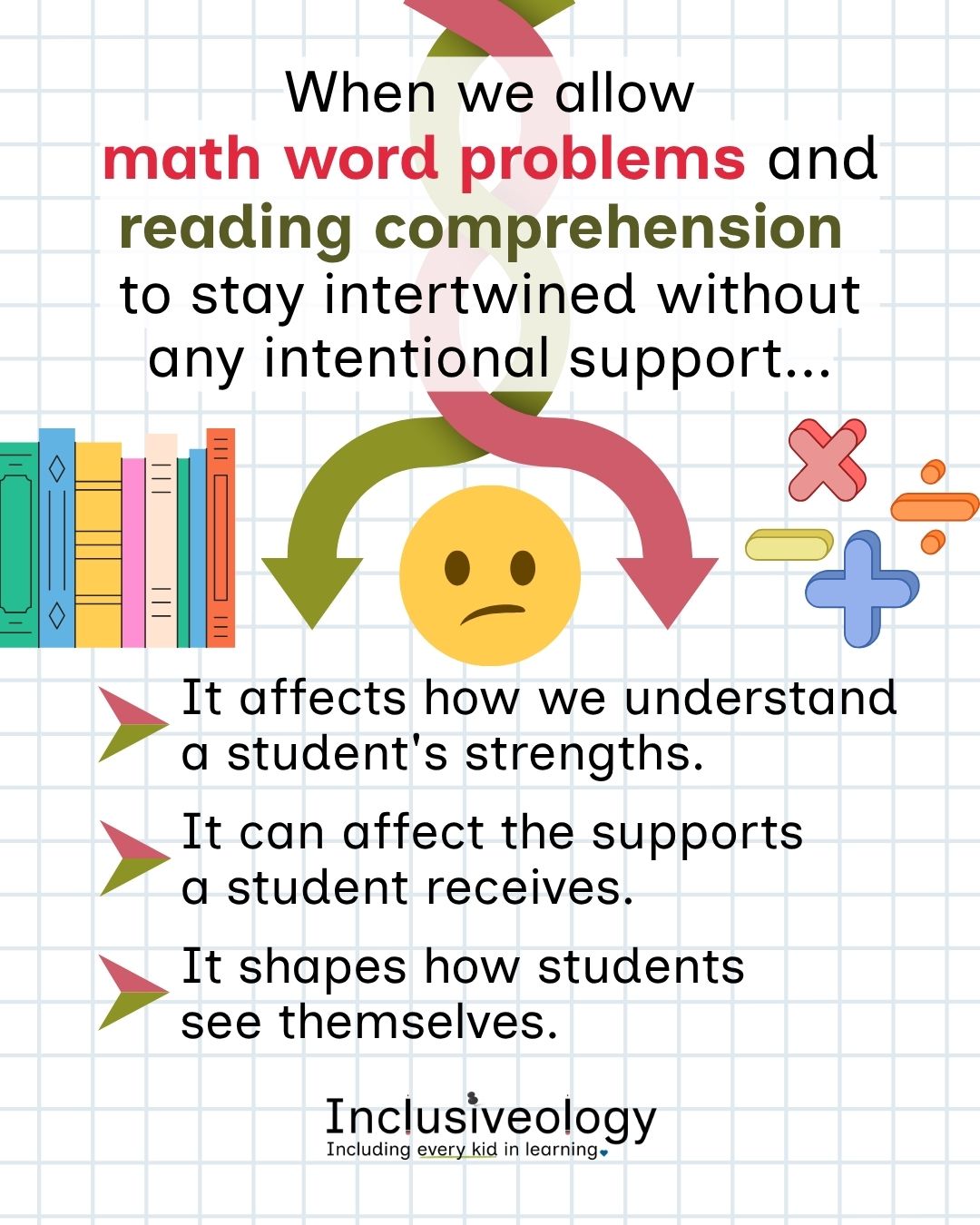
When we allow math word problems and reading comprehension to stay intertwined without any intentional support, we run a real risk of misreading what a student actually knows mathematically. A student who reads at a lower level may appear to be struggling with math concepts when what they are actually encountering is a reading access issue.
This matters in a few important ways.
First, it affects how we understand a student’s strengths. Presumed competence, a value at the heart of inclusive education, means we start from the belief that every student is capable of complex thinking and mathematical reasoning. When a student’s math accuracy is tied to their reading level, we may be underestimating their actual mathematical ability.
Second, it can affect the supports a student receives. If a student is flagged as having a math disability based on word problem performance, but the barrier is reading access, the intervention plan may not actually address what the student needs.
Third, it shapes how students see themselves. A student who consistently gets math word problems wrong, despite understanding the underlying concepts, may begin to believe they are not good at math. That is a belief worth preventing.
Practical Supports That Make Math Word Problems Accessible
The goal here is to preserve the mathematical rigor of the problem while removing the reading barrier. These supports are appropriate at Tier 1 for all learners and can be intensified at Tier 2 for students with more significant reading access needs.
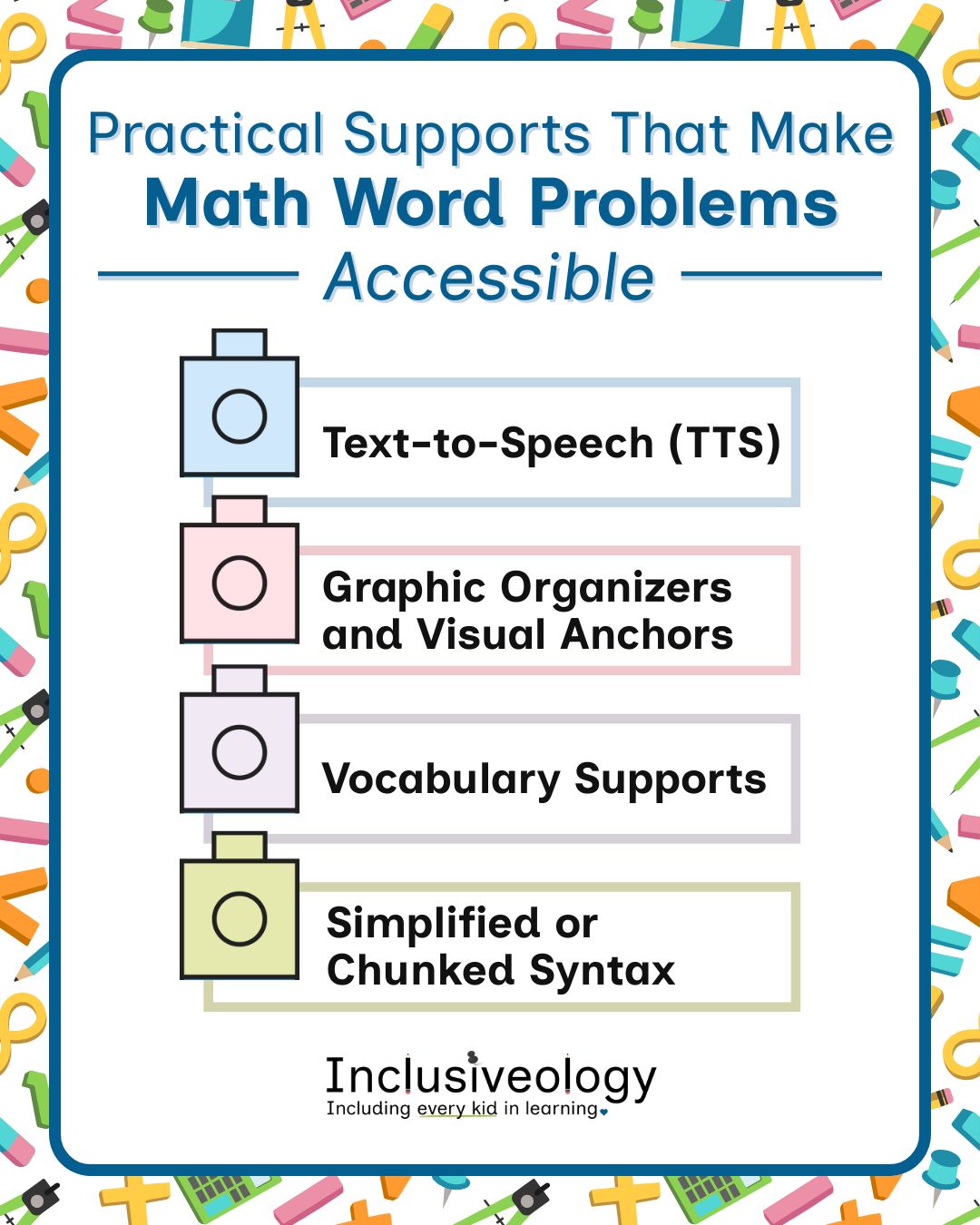
Text-to-Speech (TTS)
Text-to-speech tools allow students to hear the word problem read aloud rather than decode it independently. This one support can change the entire experience of a math word problem for a student who needs reading assistance.
When Michael hears the word “harvest” spoken aloud, he understands the context immediately. No decoding effort required. His working memory stays available for the math.
TTS tools are widely available, many of them at no cost, and they are appropriate for any student, not just those with an IEP or 504 plan. This is a Universal Design for Learning (UDL) support that benefits the whole class.
Graphic Organizers and Visual Anchors
A graphic organizer gives students a visual structure for organizing the information in a word problem before they attempt to calculate anything. A “Part-Part-Whole” template, an area model, or a simple “What do I know / What do I need to find out” chart can help a student see the structure of the problem without having to hold it all in working memory simultaneously.
When Michael uses an area model, he can visually recognize that “14 rows of 26” is a multiplication situation. The organizer does not do the math for him; it helps him see the pathway through the problem.
Vocabulary Supports
Math word problems often include vocabulary that is specific to the context of the problem, not the math itself. Words like “harvest,” “distribute,” “community,” and “remaining” are comprehension challenges, not math challenges.
A small vocabulary anchor, whether that is a simple icon, a brief definition, or a visual symbol placed next to a key word, can bridge the gap between decoding and understanding. A division symbol placed near the word “half” in Michael’s problem would have connected the language to the mathematical operation he already understood.
Simplified or Chunked Syntax
Long, multi-clause sentences are cognitively demanding for students who need reading supports. When possible, consider presenting word problems in shorter sentences or chunking the information into clearly separated steps. The mathematical content stays the same; the sentence structure becomes more accessible.
This is especially useful as a Tier 1 support during instruction, while the more complex original version of the problem is preserved for assessment when appropriate accommodations are in place.
What Michael’s Experience Looks Like with Supports
Let’s return to Michael’s carrot problem, this time with supports in place.
He listens to the problem through a TTS tool. Hearing “harvest” in context, he immediately understands what the gardeners are doing. His working memory is not taxed by decoding.
He uses an area model graphic organizer. He identifies that 14 rows of 26 is a multiplication problem and calculates 14 × 26 = 364.
He notices the word “half,” reinforced by a small division symbol icon in the margin. He knows what to do next. He divides 364 by 2 and arrives at 182.
Michael demonstrates 5th-grade mathematical mastery, because the reading access barrier was removed. The math was always there. The supports simply made it possible for him to show it.
Keeping Mathematical Rigor Intact
A question that comes up often in these conversations is whether providing reading supports somehow makes the math easier or less rigorous. It does not.
The mathematical thinking required to solve a multi-step multiplication and division problem stays exactly the same whether a student reads the problem or hears it. The graphic organizer does not perform the calculation. The vocabulary support does not identify the operation. The student does all of that.
What changes is whether the student can access the problem at all. Removing a reading barrier is about access, and access is what makes mathematical reasoning possible.
During math instruction and assessment, the goal is to see their mathematical thinking, and that is exactly what these supports make visible.
A Mindset Shift Worth Making
One of the most meaningful shifts an inclusive classroom teacher can make is learning to look past a wrong answer and ask: what was the actual barrier here?
When a student who needs reading supports gets a math word problem wrong, the answer is often found in the intersection of math word problems and reading comprehension, not in the student’s mathematical ability. The supports exist. They are practical, low-tech in many cases, and appropriate for any classroom.
Every student deserves instruction that meets them where they are, and that includes making sure reading is never the thing standing between a student and their mathematical potential.

| Want more practical, inclusive strategies for your classroom? Come get snuggled in at the Inclusiveology community, where teachers are building classrooms that work for every kid. Join us at Inclusiveology.com/join. 💙 |