Alternative Math Tools and Strategies That Help Every Student Succeed
When I was in high school, I failed Math every single year and spent my summers in Math school making up credits. Looking back, I struggled with number sense for most of my education. That changed in Graduate Statistics, where I finally encountered Math in a way that made sense to me. I had a real research purpose, supportive tools like calculators and process charts, a peer to cross-check my work, and an instructor who treated me as mathematically capable. I earned an A.
That experience stayed with me. When I became a teacher, I thought often about what Mrs. Turner, my high school Math teacher, could have done to reach me. I attended every Math workshop and professional development session I could find, determined to understand how students who learn differently experience numbers, and how to give them real pathways to success.
Why Math Tools and Strategies Matter
Consider how we approach reading support. When a student struggles to access a textbook, we offer audiobooks, graphic organizers, and assistive technology without hesitation. Math support deserves the same intentionality.
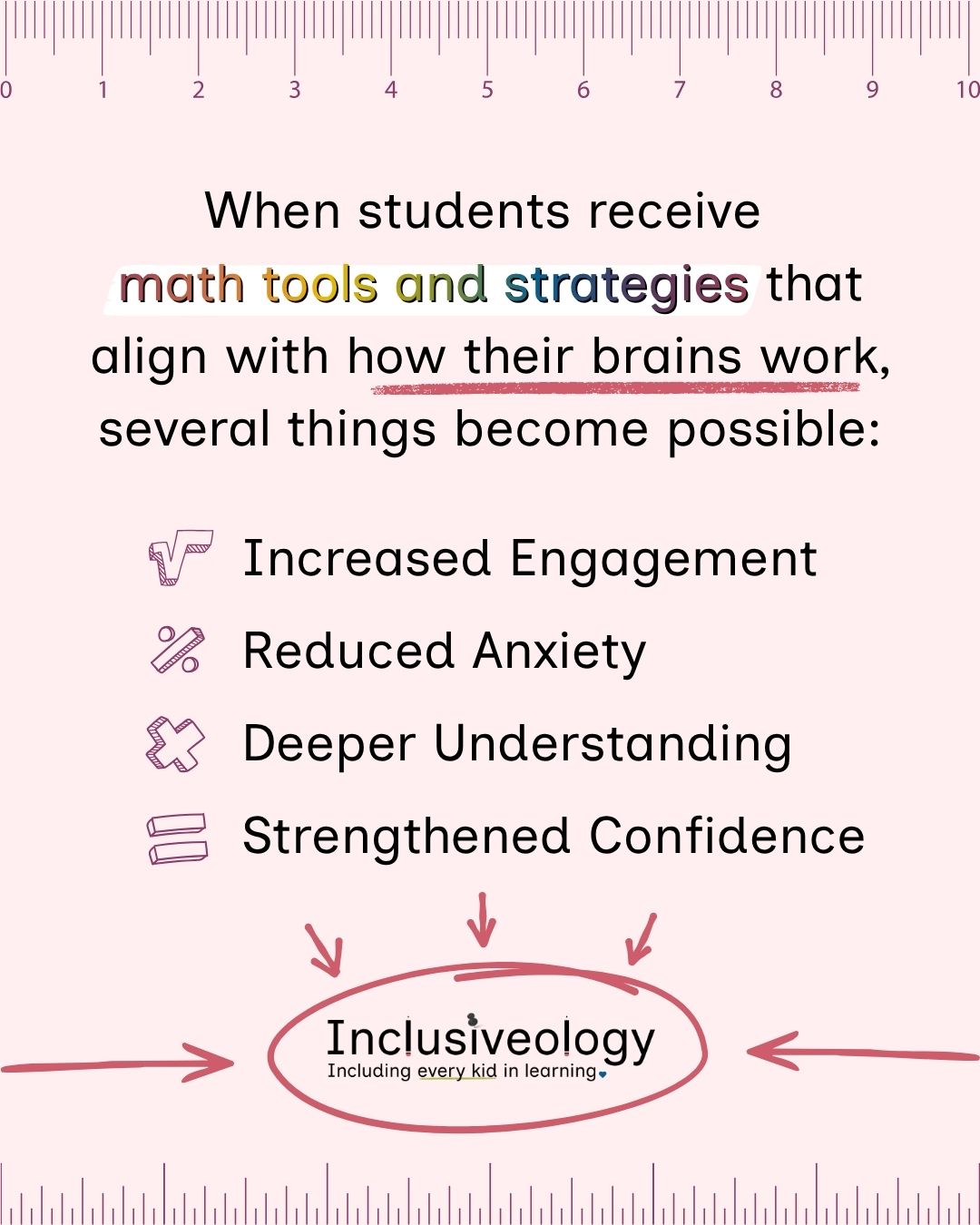
When students receive math tools and strategies that align with how their brains work, several things become possible:
- Increased Engagement: Math becomes more tangible and less abstract. Students grow more curious and invested when they can interact with concepts in ways that feel accessible to them.
- Reduced Anxiety: When there are multiple ways to approach a problem, the pressure of a single “right” method lifts. Students can focus on mathematical thinking rather than on managing fear of failure.
- Deeper Understanding: Hands-on experiences and visual representations build conceptual understanding in ways that rote memorization alone cannot. Students move from performing procedures to genuinely understanding them.
- Strengthened Confidence: Every experience of success, including success supported by a tool, builds self-efficacy. Students begin to see themselves as mathematical thinkers, and that identity shift matters.
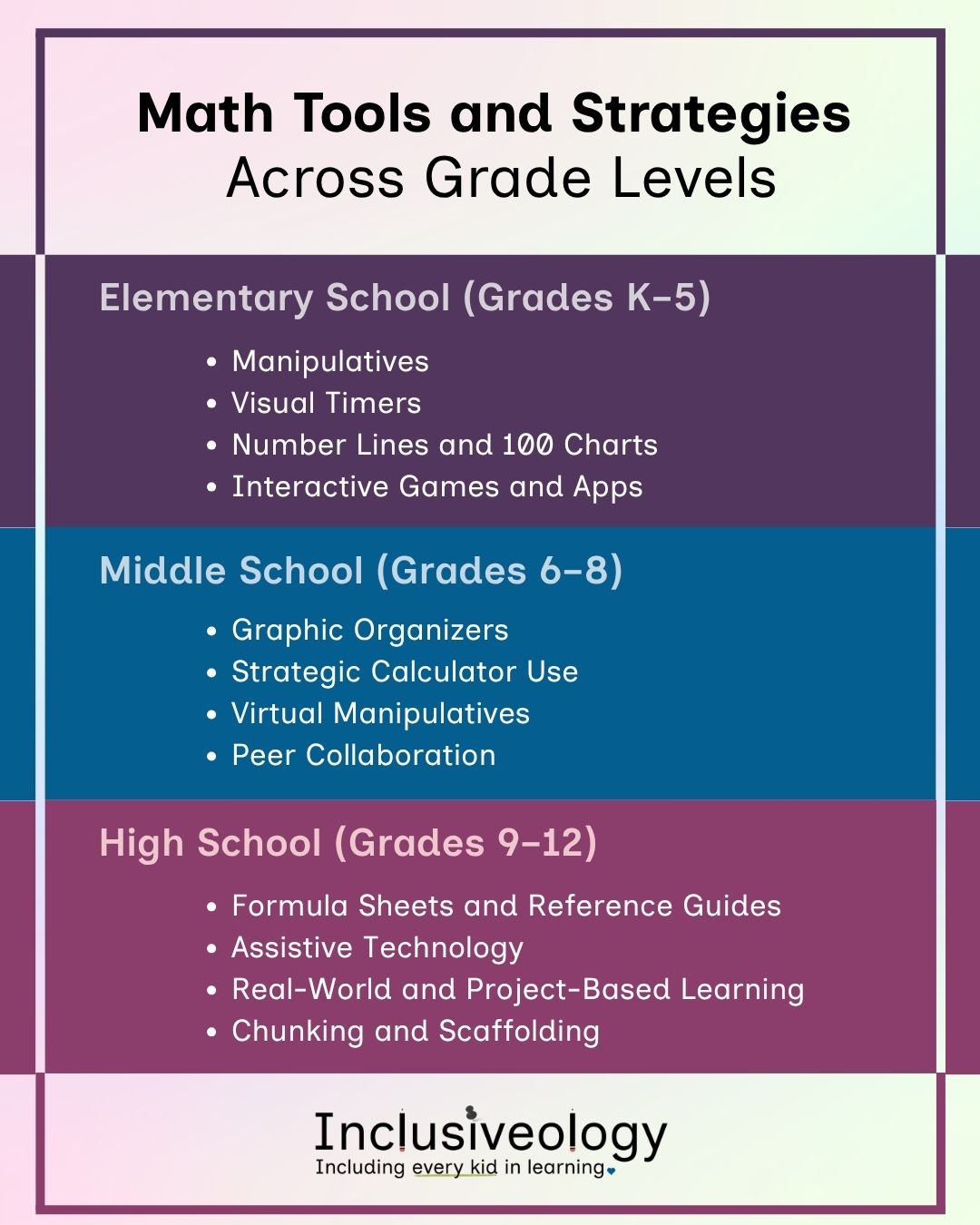
Math Tools and Strategies Across Grade Levels
One of the greatest strengths of an inclusive approach to Math instruction is adaptability. The following tools and strategies can be implemented across the K–12 span and adjusted to meet individual student needs.
Elementary School (Grades K–5)
- Manipulatives: Unifix cubes, base ten blocks, fraction tiles, and Cuisenaire rods help young learners physically represent numbers, operations, and fractions. Students with sensory considerations can choose a manipulative that suits their tactile preferences, supporting both access and regulation.
- Visual Timers: For students who experience challenges with transitions or sustained focus, visual timers create predictability during Math activities. Sand timers, digital timers, and Time Timers each offer a slightly different sensory experience, so offering choice is worthwhile.
- Number Lines and 100 Charts: These visual aids give students a concrete way to navigate number sequences and support addition, subtraction, and skip counting. Large anchor charts posted in the classroom and personal mini charts at students’ desks extend access throughout the day.
- Interactive Games and Apps: Engaging digital tools make practicing foundational Math skills more accessible and more enjoyable. Many apps offer built-in differentiation, allowing students to work at a pace and level that fits their current understanding.
Middle School (Grades 6–8)
- Graphic Organizers: Flowcharts for multi-step problem-solving, KWL charts for introducing new topics, and concept maps for exploring relationships between mathematical ideas all support students in organizing their thinking before, during, and after instruction.
- Strategic Calculator Use: Mental Math is a valuable skill, and calculators are a valuable tool. For students who experience challenges with basic computation, strategic calculator use reduces cognitive load and allows them to direct their energy toward higher-order problem-solving.
- Virtual Manipulatives: Online versions of physical manipulatives, including algebra tiles and geometric shape tools, can be accessed from anywhere and offer a dynamic, low-barrier way to explore abstract concepts.
- Peer Collaboration: Structured peer learning gives students access to different perspectives and creates opportunities to articulate their own mathematical thinking. For many students, explaining a concept to a peer is when understanding solidifies.
High School (Grades 9–12)
- Formula Sheets and Reference Guides: Well-organized reference materials during assessments support recall and reduce anxiety, particularly for students with working memory challenges. Providing these tools communicates that understanding the mathematics matters more than memorizing the formula.
- Assistive Technology: Text-to-speech, speech-to-text, and screen magnification tools are meaningful supports for students with learning disabilities or visual impairments. These tools remove barriers to accessing math content and to demonstrating mathematical knowledge.
- Real-World and Project-Based Learning: Connecting abstract mathematical concepts to practical, real-world applications makes the learning feel relevant. When students can see why a concept matters, they engage with it differently.
- Chunking and Scaffolding: Breaking complex problems into smaller, sequenced steps gives students clear entry points and reduces overwhelm. Each completed step builds momentum and supports students in sustaining focus through multi-stage problems.
Every Student Can Access Mathematics
The students sitting in your classroom right now include kids who will find their mathematical footing in a hands-on manipulative, a well-timed calculator, a peer conversation, or a real-world problem that finally makes the numbers feel meaningful. The tools exist. The strategies are teachable. And no student should have to wait until graduate school to feel mathematically capable.
When we equip students with math tools and strategies that honor how they learn, we build more than mathematical skill. We build resilience, flexible thinking, and the confidence to take on new challenges.
Every student deserves a teacher who believes they can get there, and a toolbox that helps them do it.
Ready to build yours?
| Join the Inclusiveology community at Inclusiveology.com/join and get access to inclusive strategies, Solution Sessions, and a community of educators who are figuring this out together. 💙 |