Alternative Knowledge Assessments for Students Who Read Below Grade Level
When a student reads below grade level, traditional tests often measure their reading ability rather than their content knowledge. For teachers working with neurodivergent learners or students with developing decoding and fluency skills, this gap can be significant. Alternative knowledge assessments offer a way to see what students actually know, without reading comprehension getting in the way.
What You’ll Learn
- Why traditional assessments can misrepresent content knowledge for students who read below grade level
- How one 5th grade teacher used an alternative knowledge assessment to capture what a student truly understood about ecosystems
- Practical tools and strategies you can apply across content areas
When the Assessment Measures the Wrong Thing
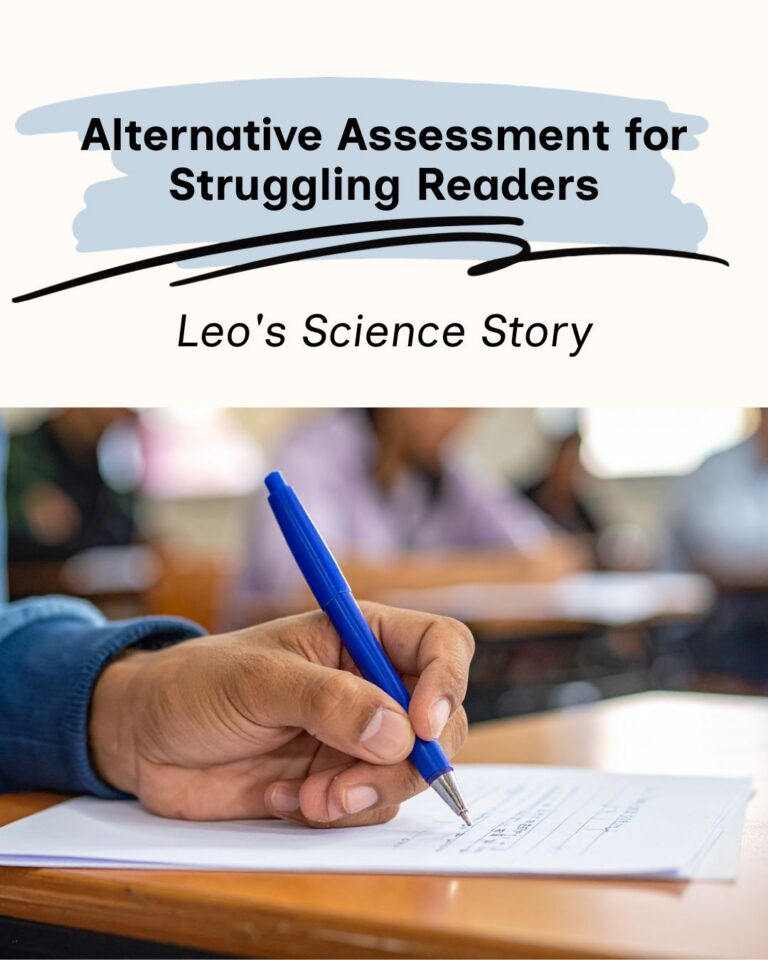
Leo is a 5th grader who reads below grade level. During a science unit on ecosystems, he was the first to correctly predict how introducing a new predator would affect a food web. He was engaged, curious, and clearly understood the content.
Then came the written chapter test.
Because the assessment relied heavily on reading comprehension and written expression, Leo’s score did not reflect what he knew. His science grade reflected his reading level, and that is a problem worth solving.
This is exactly the challenge one teacher brought to a coaching session. Her goal: find a way to capture content knowledge for students whose decoding and fluency were still developing, so that their science understanding could finally be seen and measured accurately.
The solution was to decouple the assessment of content knowledge from the mechanical act of reading and writing. Remove that barrier, and a much clearer picture of student understanding becomes visible.
What Alternative Knowledge Assessments Look Like in Practice
For Leo’s ecosystem assessment, the objective was straightforward: demonstrate an understanding of how energy flows in an ecosystem and predict the impact of introducing a wolf into an existing food web with a deer population.
Instead of writing about it, Leo built it.
Using Padlet, a digital whiteboard tool, Leo arranged visual images of organisms (wolves, deer, grass) on the screen and drew arrows to show energy flow. A peer dragged a “new predator” image into the web to simulate the disruption.
Then Leo turned on the screen record and microphone feature and narrated what he observed: “Since the wolves eat deer, the deer population will go down. Because there are fewer deer, the grass might grow taller because fewer animals are eating it.”
That is a student demonstrating mastery. His science score finally reflected his science knowledge.
Why This Approach Works
Alternative knowledge assessments work because they shift the focus to what a student understands rather than how fluently they can decode text. For students who read below grade level, this distinction matters enormously.
This approach aligns directly with Universal Design for Learning (UDL), specifically the principle of multiple means of expression. UDL asks teachers to offer students more than one way to show what they know. For Leo, that meant a digital model and an oral explanation. For another student, it might mean a drawing, a verbal response recorded on a device, or a hands-on demonstration.
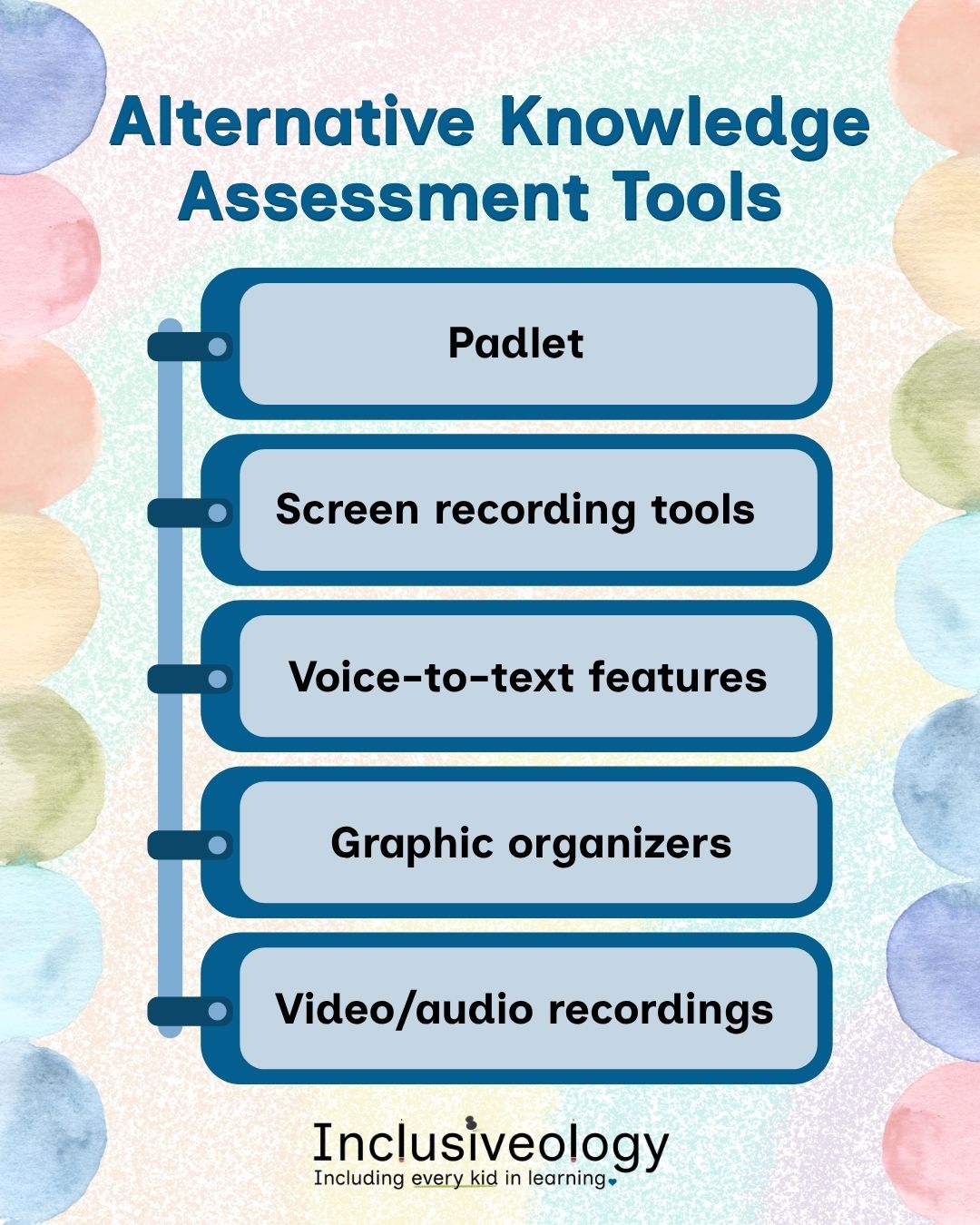
The tools available to support this kind of assessment are more accessible than ever:
- Padlet for digital modeling and visual organization
- Screen recording tools (built into most tablets and Chromebooks) for capturing verbal explanations
- Voice-to-text features for students who can express ideas verbally but struggle with written output
- Graphic organizers paired with verbal response options
- Video or audio recordings as a substitute for written responses in content-area subjects
None of these require specialized technology training. Many are already available on the devices in your classroom.
Expanding This Beyond One Student
Leo’s assessment was designed with his strengths in mind, and that is exactly the right starting point. When you design with the student who needs the most support at the center, the approach often opens up possibilities for the whole class.
Consider how many students in a typical 5th grade classroom would benefit from showing what they know through a digital model, a recorded explanation, or a visual representation. Students with developing language skills, students managing anxiety around written tests, and students who simply process and express ideas more effectively when they can speak or build rather than write, all stand to gain from this shift.
Alternative knowledge assessments are a practical, equity-centered move. Every student deserves a chance to show what they actually know about the content being taught.
A Starting Point for Your Classroom
If you are ready to explore alternative knowledge assessments in your own practice, start small. Choose one upcoming content-area assessment and ask: is there a way for students to demonstrate this knowledge without relying solely on reading and writing?
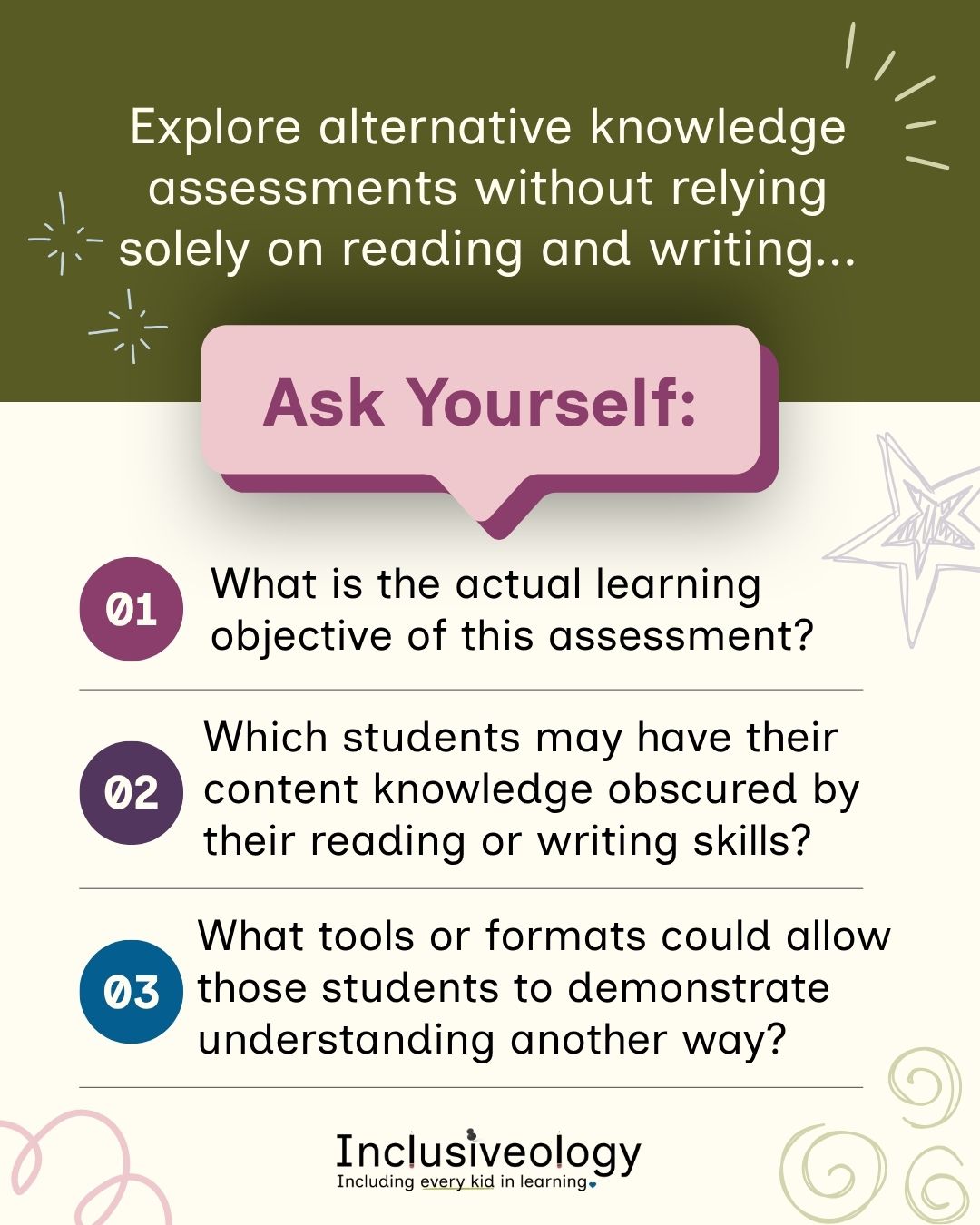
A few questions to guide your thinking:
- What is the actual learning objective of this assessment?
- Which students may have their content knowledge obscured by their reading or writing skills?
- What tools or formats could allow those students to demonstrate understanding another way?
You do not need to redesign every assessment at once. One shift, for one student, can open the door to a whole new way of seeing what your learners know.
Ready to Build Your Assessment Toolbox?
| Alternative knowledge assessments are one piece of a larger inclusive instructional practice. Inside the Inclusiveology community, you will find strategies, coaching support, and a toolbox of resources designed to help you meet every learner where they are. Join us at Inclusiveology.com/join 💙 |