

Beyond the Diagnosis: A Data-First Approach to Building Individualized IEP Support
If you have a student with a 504 Plan or an IEP in your classroom, their IEP support needs shift depending on the area, not the label on their file. A diagnosis tells part of a child’s story. The rest comes from watching, testing, and listening to what a student can do right now, and what they need help with next.
A common misconception is that a diagnosis dictates the entire learning plan. In reality, a student can have high support needs in one area and low support needs in another. One child might need significant academic help while managing social situations with ease. Another might read above grade level and still need real support with behavior or peer interactions.
Take a student named Michael. Michael has an autism diagnosis, and that single word can make a team assume he needs support across every category: academics, behavior, social skills, and communication. Maybe he only needs a few of those supports, not all of them. Figuring out which ones takes more than a diagnosis. It takes data.
What You’ll Learn
- Why a diagnosis is a starting point, not a full plan
- How to read evaluation data instead of a label
- A “dial” model for setting support levels by area
- How to write goals that are specific and measurable
- Why an IEP needs monitoring and adjusting all year long
Moving Beyond the Label
Evaluations, diagnoses, and eligibility categories matter for legal and funding reasons. They open the door to services. They don’t describe the specific, practical support a child needs on a Tuesday morning during reading group or during a transition between subjects.
The real work of an IEP team begins after the label is assigned, when everyone looks at the actual assessment data to determine what a student can do, where they struggle, and what kind of support closes that gap. The diagnosis gets a child to the table. The data decides what happens once they’re there.
Turning Evaluation Data Into Action
Once a team has the evaluation results in hand, the next step is translating that data into classroom strategies. Here’s how to shift the focus from label to action.
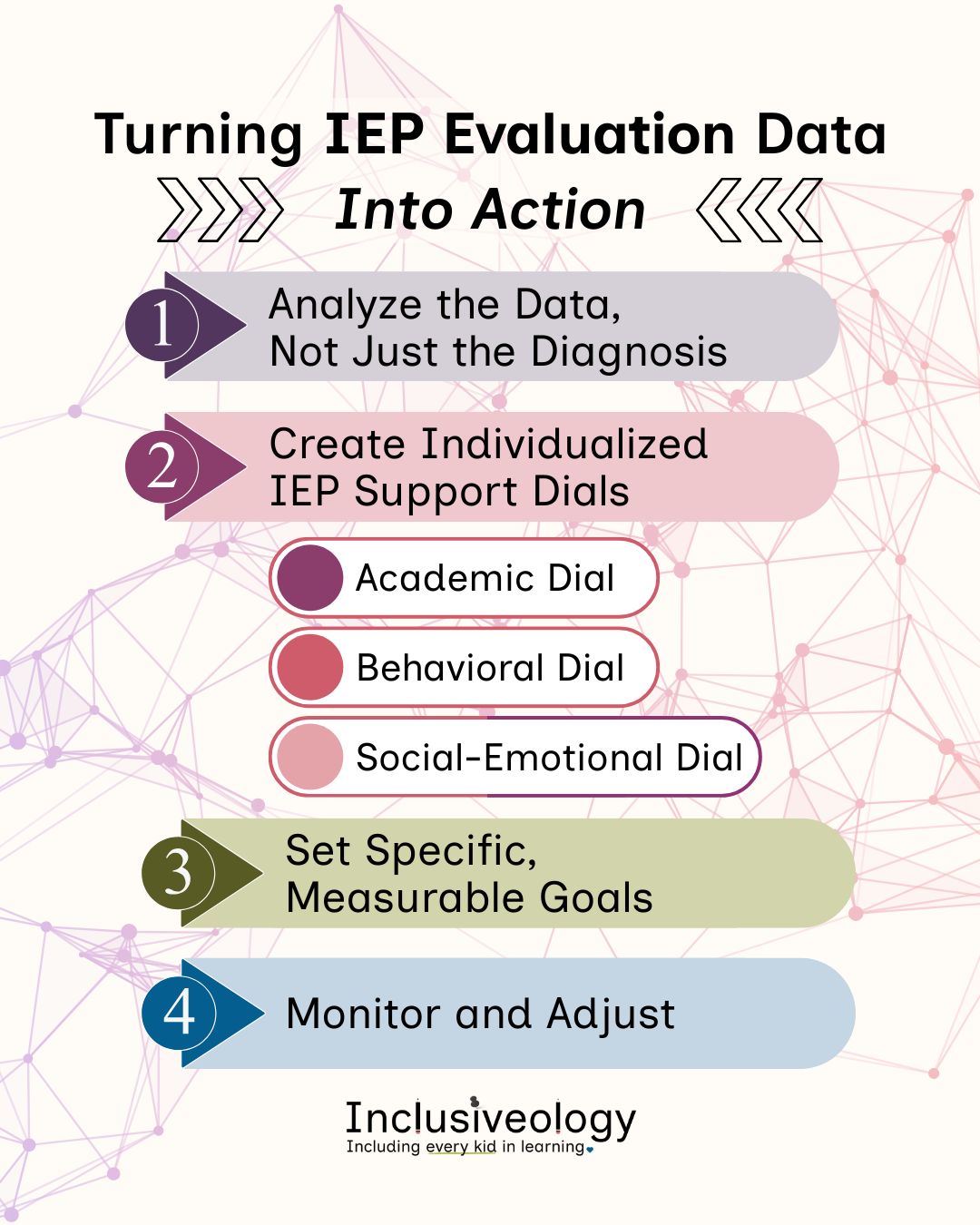
Analyze the Data, Not Just the Diagnosis
Look past terms like “autism spectrum disorder” or “specific learning disability” and into the specific data points underneath them. If an evaluation shows a student struggles with phonemic awareness, that’s a high support need in reading, and the IEP should include targeted interventions and goals in that exact area. If the same evaluation shows strong math skills, that’s a low support need, and the IEP might focus on maintaining and extending those skills with minimal intervention.
Create Individualized IEP Support Dials
Picture each area of need as a dial that can be set anywhere from low to high. The IEP team collaboratively sets that dial for academics, behavior, and social-emotional learning based on the data, not the diagnosis.
- Academic Dial: Does the student need one-on-one reading instruction, or is a quiet space for test-taking enough?
- Behavioral Dial: Does the student need a formal behavior plan with frequent check-ins, or do visual schedules cover it?
- Social-Emotional Dial: Does the student need a social skills group, or do simple peer-interaction prompts do the job?
This model helps a team build a plan that treats each area of need on its own terms instead of applying one blanket level of support across the board.
Set Specific, Measurable Goals
Every goal should trace back to a dial setting. A vague goal like “the student will improve reading skills” gives a team nothing to measure and nothing to plan around. A goal like “given a list of 20 CVC words, the student will read them with 80% accuracy in four out of five trials” gives everyone a clear target and a clear way to track progress, tied directly to the data pulled from the evaluation.
Monitor and Adjust
An IEP is a living document, and a team can amend it at any point in the year. Progress toward each goal needs regular monitoring, and when a strategy isn’t landing, the dials need to move. That might mean turning up support in one area as new challenges surface, or turning it down in another as a student builds independence. This ongoing check-in keeps the plan matched to the student sitting in front of the team, not the student described on paper months earlier.
A Better Way to Support Every Learner
A data-first approach to IEP support needs gives every student a plan built around what they actually need. Parents and educators who commit to this kind of planning give kids something far more useful than a label: a road map built just for them.
| Want more practical strategies for building inclusive classrooms and confident IEP teams? Join Inclusiveology and get weekly tools, coaching, and community built for teachers doing this work every day. 💙 Inclusiveology.com/join |