From Lecture to Facilitated Learning: Encouraging Kids to be Active Learners
You’re standing at the front of the classroom, delivering what feels like a clear, purposeful lesson. You see nods. A few students are taking notes. A hand or two goes up. The content is solid.
But were all students truly engaged?
Were they building their own understanding, or receiving information and waiting to see if it would stick?
This question sits at the heart of the shift from a lecture-style, teacher-centered classroom to one where the teacher facilitates learning. And it’s a shift worth making, because the research and the real classroom evidence both point in the same direction: when students are active participants in their own learning, outcomes improve across the board.
Here’s what that shift looked like for one teacher I coached, and what it can look like in yours.
What Lecture-Style Teaching Looks Like
In a lecture-style classroom, the teacher is the primary source of knowledge. Information flows one direction, from teacher to student. Students are expected to absorb, remember, and recall what they’ve been taught, often without much opportunity to interact with the content themselves.
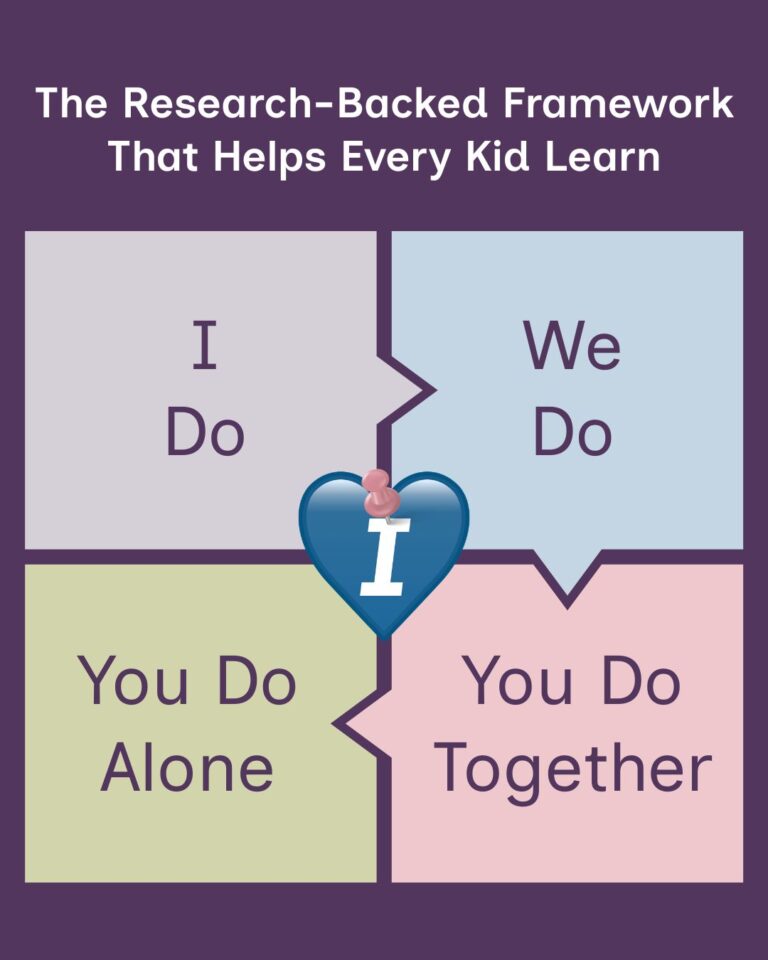
This approach has its place. Direct, explicit instruction is a meaningful part of the Gradual Release Model. The “I Do” phase, where the teacher models thinking and demonstrates a skill, is essential. The question is what comes next, and whether students are ever given the chance to do anything with what they’ve just heard.
Let me show you what I mean through a real coaching story.
A Real Classroom Story: Ms. G’s 3rd Grade ELA Lesson
Ms. G was teaching a 3rd grade lesson on identifying the main idea and supporting details. She had a great article about a new dinosaur discovery and a clear learning objective. Her first attempt was thorough, well-intentioned, and delivered entirely by her.
The First Attempt: Teacher-Led Delivery
Ms. G stood at the front of the class, held up the article, and explained the concept. She defined the main idea, offered an analogy, and pointed out examples as she read aloud. She paused to ask questions. A few students raised their hands. She provided the answers and moved on.
The content was delivered. But here’s the question we kept coming back to in our coaching conversations: how did Ms. G know which students were actually retaining the information? And which students were sitting on the sidelines, waiting for the right answer to be revealed rather than working to construct their own understanding?
That’s where we started making adjustments.
The Adjustment: Facilitated Learning in Action
The next day, Ms. G re-taught the lesson with one significant change: students were doing the work.
She organized her class into small groups, gave each group a copy of the article, highlighters, and sticky notes, and introduced them as “main idea detectives.” Their job was to figure out the most important message in the article and find the clues that supported it.
She also offered a visual anchor: the main idea as the trunk of a tree, strong and central, with the details as branches and leaves growing outward. Then she gave clear, structured instructions:
- Read through the article together as a group.
- Use highlighters to mark sentences that feel important.
- On a sticky note, write one sentence that captures the most important thing the author wants you to know. That’s your group’s main idea.
- Find at least three more details from the article that support your main idea, each on its own sticky note.
As groups worked, Ms. G moved through the room listening. She asked open-ended questions: “What makes you think that’s the main idea?” and “How do those details connect back?” For groups that were struggling, she offered guiding questions rather than answers, prompting them to re-read or talk it through together.
After about 15 minutes, the class came back together. Each group shared their main idea and supporting details. Students discussed similarities, differences, and justified their choices with evidence from the text. Ms. G facilitated the conversation, making sure every voice had space in the room.
What Facilitated Learning in the Classroom Actually Changes
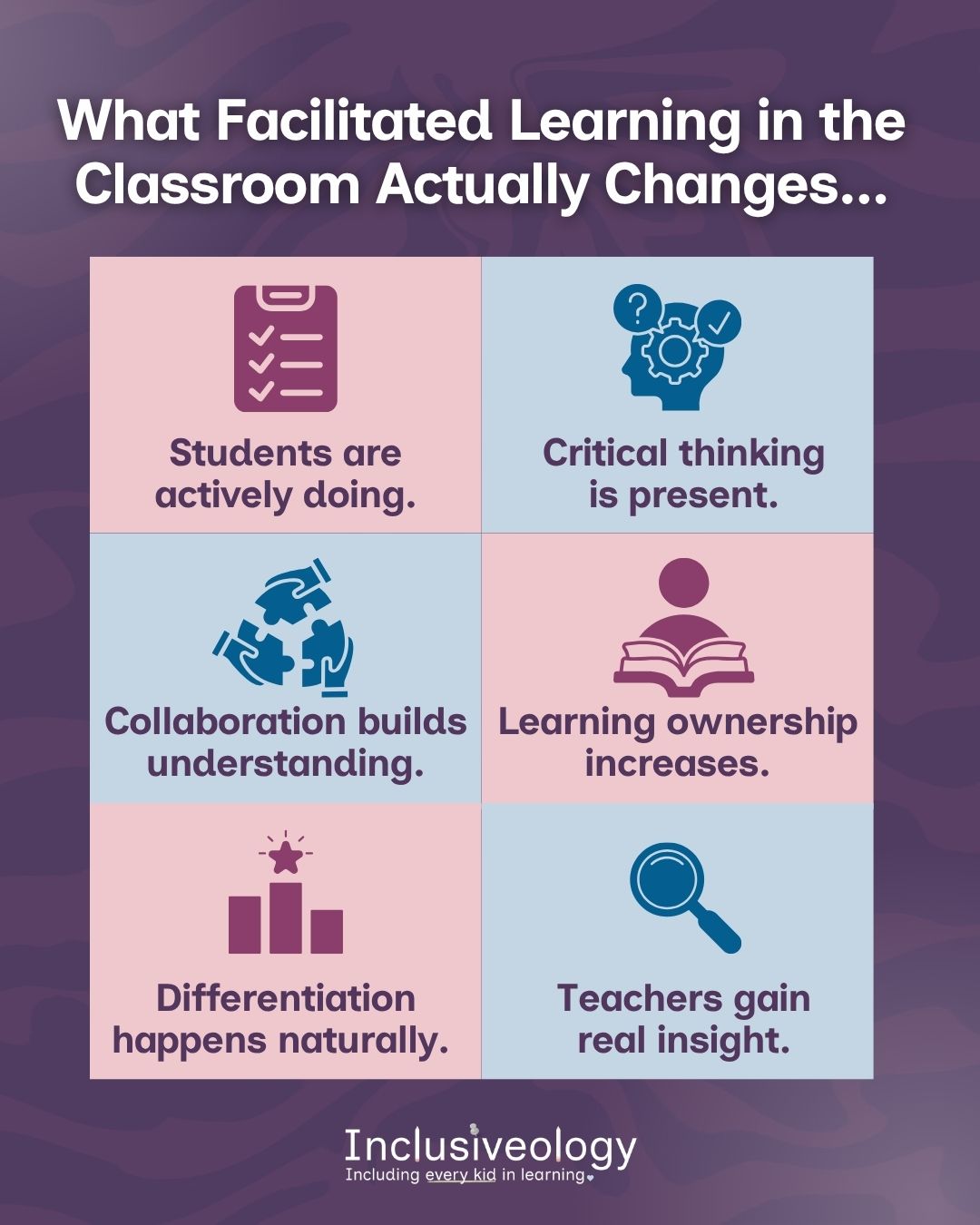
In the coaching conversations that followed, Ms. G and I talked through what made the second lesson different. Here’s what we identified:
- Students were actively doing. Reading, discussing, highlighting, writing, and justifying their thinking out loud.
- Critical thinking was present. Students were making sense of new information rather than memorizing what the teacher said.
- Collaboration built understanding. Students learned from each other and practiced communication alongside content.
- Learning ownership increased. When students discover answers themselves, what they learn tends to stick.
- Differentiation happened naturally. Students could work at their own pace and contribute in ways that suited their strengths.
- Ms. G gained real insight. By observing group interactions, she could identify misconceptions and know exactly where to reteach.
This last point is worth sitting with. In the lecture-style version, Ms. G received very little information about what her students actually understood. In the facilitated version, she had a front-row view of every student’s thinking. That’s a meaningful shift for any teacher supporting diverse learners, including students with IEPs, neurodivergent learners, and kids who process information in non-traditional ways.
Making the Shift Toward Facilitated Learning
Facilitated learning doesn’t mean stepping back entirely. The teacher still designs the experience, introduces the concept, and provides structure. What shifts is the role: from delivering information to creating conditions where students can work with it.
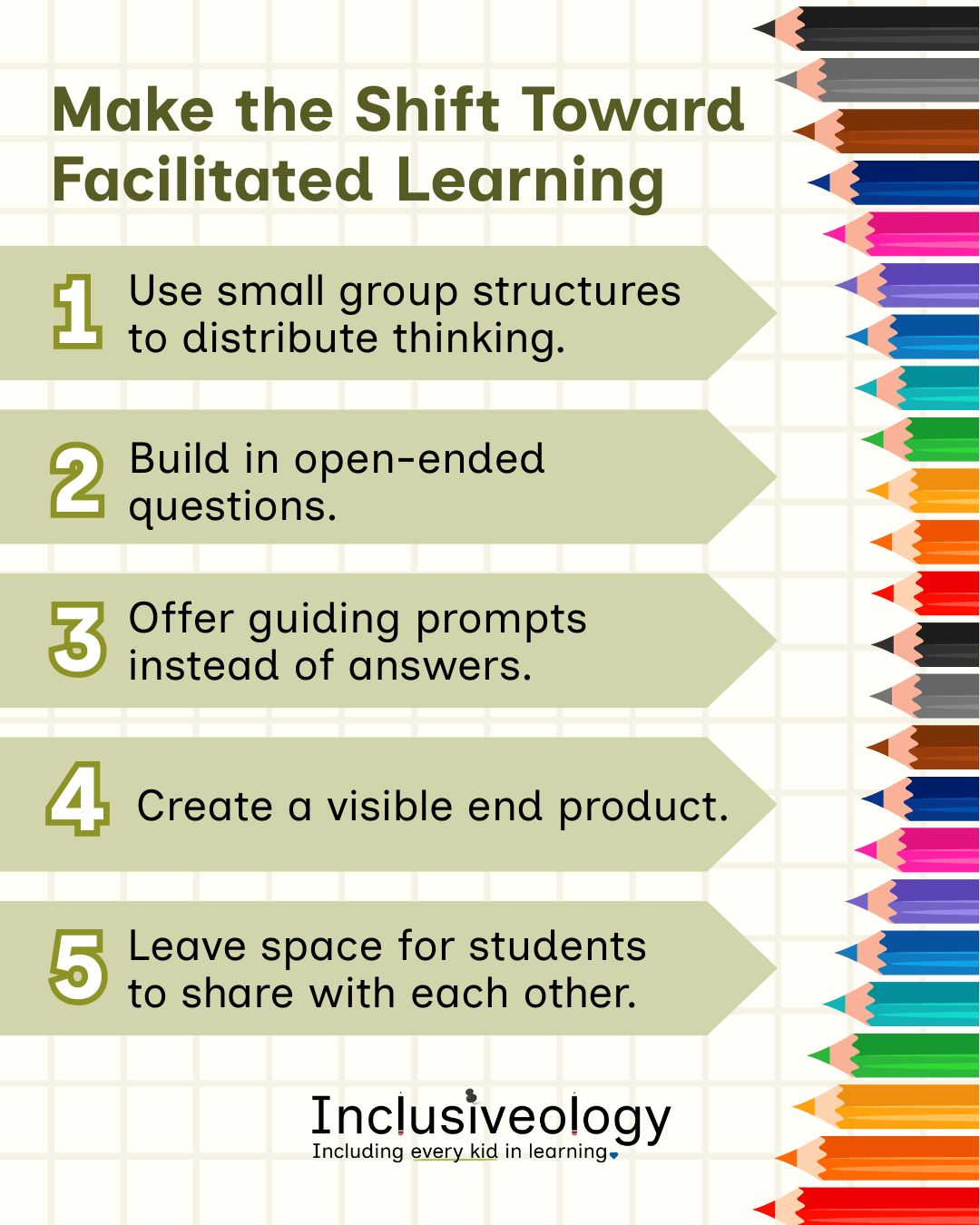
A few entry points that work well:
- Use small group structures to distribute thinking. Instead of one student answering, every group works toward an answer at the same time.
- Build in open-ended questions. Questions without a single right answer push students to reason, not just recall.
- Offer guiding prompts instead of answers. When a student is stuck, “What does the text say about that?” often works better than filling in the gap for them.
- Create a visible end product. Sticky notes, annotated articles, graphic organizers, and group charts give students something concrete to build, and give you something concrete to observe.
- Leave space for students to share with each other. Peer-to-peer explanation deepens understanding in ways that teacher-to-student explanation often can’t.
The Gradual Release Model of Instruction provides a useful framework here: starting with explicit teacher modeling, moving through guided and collaborative practice, and releasing students toward independent work. Facilitated learning lives in that middle stretch, and it’s where some of the most meaningful learning happens.

| Ready to Build a More Inclusive, Student-Led Classroom? Inside the Inclusiveology community, you’ll find practical strategies, coaching support, and a toolbox of resources designed to help you reach every kid in your classroom, including those who need the most from you. Join us at Inclusiveology.com/join and get snuggled in. 💙 |