Dyscalculia Supports Every Teacher Should Know
Many of us have heard of dyslexia, a learning disability that affects a child’s ability to identify speech sounds and learn how they relate to letters and words (decoding). But there is another learning disability that deserves just as much attention in our classrooms: dyscalculia.
Dyscalculia is a learning disability in math that affects a child’s ability to make arithmetical calculations, understand the relationship between numbers, and grasp simple number concepts. Like dyslexia, dyscalculia is considered a language-based learning disability, affecting areas of the brain that process language. Yet far fewer teachers feel equipped to recognize it, let alone support it.
That changes today.
What Is the Connection Between Dyscalculia and Other Disabilities?
Dyscalculia rarely shows up in isolation. Quite often, dyscalculia-related challenges arise alongside other disabilities such as visual or auditory processing disorders or Attention Deficit Hyperactivity Disorder (ADHD). Research shows that up to 60% of people with ADHD also have a learning disability such as dyscalculia or dyslexia (Haberstroh & Körner, 2019).
A child with dyslexia typically has the support of a special education teacher providing specially designed instruction (SDI) for reading deficits, alongside a classroom teacher offering daily accommodations. Children with dyscalculia deserve that same layered, intentional support in math.
How Does Dyscalculia Present in the Classroom?
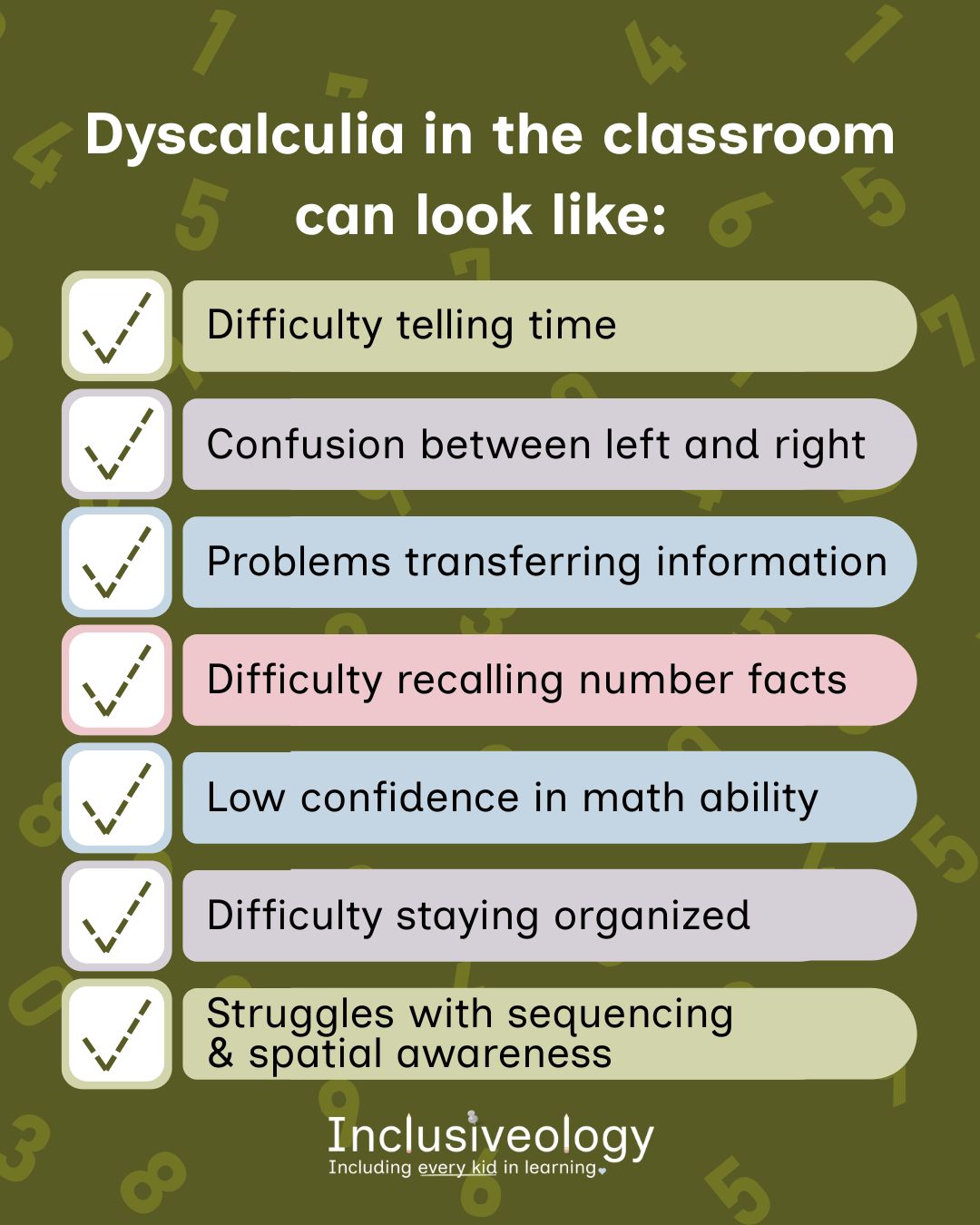
Recognizing dyscalculia is the first step toward building the right supports. Here is what it can look like in the classroom:
- Difficulty telling time
- Confusion between left and right
- Problems transferring information (e.g., understanding that 2+3=5 means 3+2=5)
- Difficulty recalling number facts such as multiplication tables or skip counting by 2s and 5s
- Low confidence in math ability and difficulty staying organized
- Struggles with sequencing and spatial awareness
These presentations can vary widely from student to student, which is exactly why a well-stocked toolbox of dyscalculia support strategies for teachers matters so much.
Dyscalculia Support Strategies for Teachers: Accommodations and Adjusted Instruction
The good news: there are concrete, classroom-ready supports available right now. Whether you are a general education teacher, a special education teacher, or an instructional coach, these strategies can make a meaningful difference.
Accommodations to Put in Place
- Allow extra time on tests and assignments.
- Provide a quiet, low-distraction space to work.
- Offer the option to record lectures or receive notes from a peer or teacher.
- Provide a calculator for computation tasks so the focus stays on mathematical reasoning.
Instructional Adjustments That Work
- Provide multisensory instruction; engage students through what they see, hear, and touch.
- Use manipulatives and real objects to make abstract number concepts concrete.
- Incorporate assistive technology tools such as math-to-speech apps, digital manipulatives, and graphic organizers designed for math.
- Encourage students to talk through, write out, or draw a problem before solving it.
- Break problems into digestible steps so students can build success one piece at a time.
- Review often and return to learning gaps with targeted small group instruction.
Assistive Technology Tools Worth Knowing
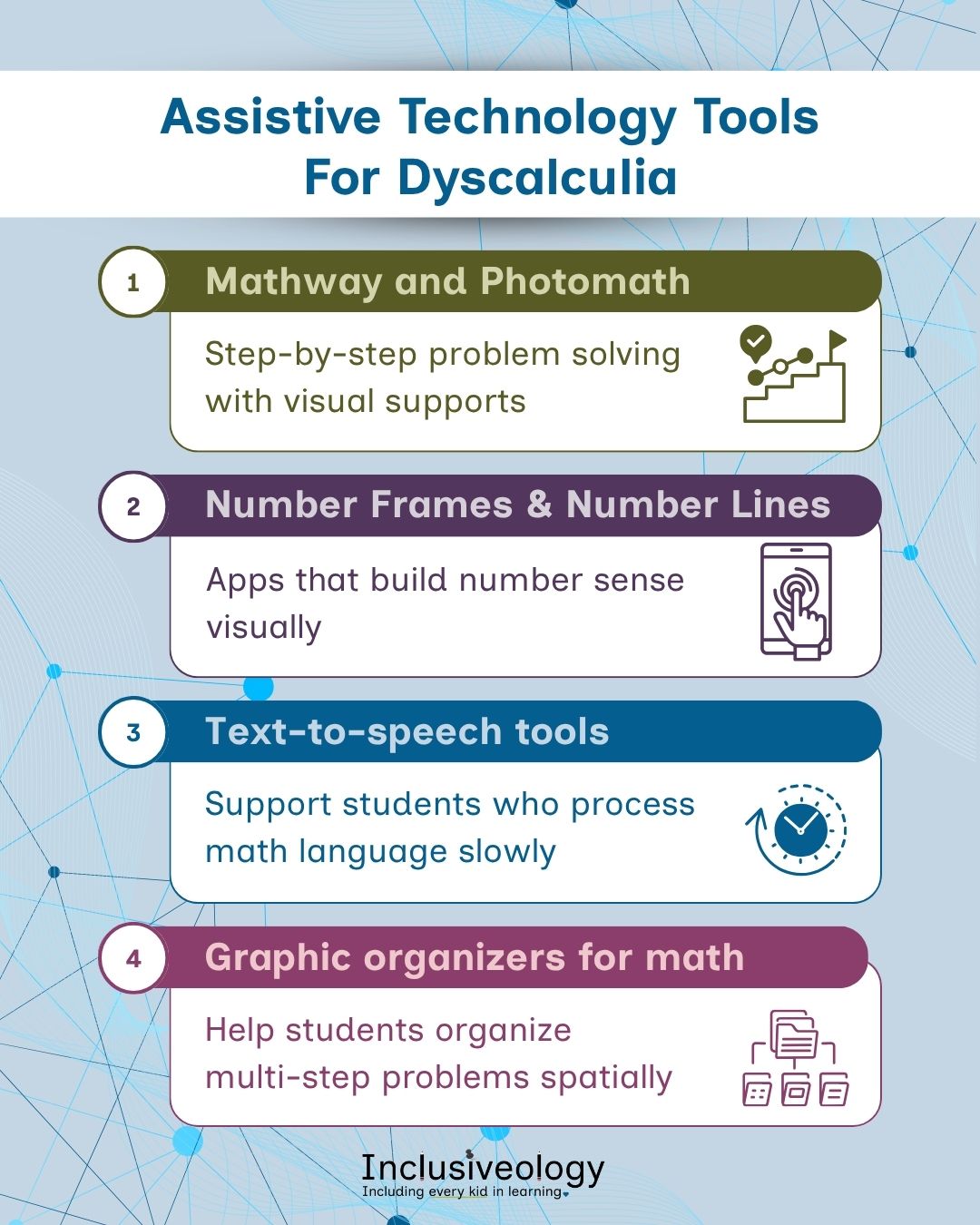
Assistive technology for dyscalculia goes well beyond the basic calculator. Here are some tools worth adding to your toolbox:
- Mathway and Photomath: Step-by-step problem solving with visual supports
- Number Frames and Number Lines (apps): Build number sense visually
- Text-to-speech tools: Support students who process math language slowly
- Graphic organizers for math: Help students organize multi-step problems spatially
These tools are not reserved for students with an IEP or a 504 Plan. Any child who benefits from them deserves access to them. That is what inclusive instruction looks like in practice.
Every Child Can Access Math
Dyscalculia is real, it is more common than many educators realize, and every teacher who works with kids deserves to feel confident supporting it. This post is a starting point. There are more strategies, more tools, and more conversations to be had.

| Inclusiveology is here to walk alongside you. Join the community, get snuggled in, and start building math supports that work for every child in your classroom. 💙 Join the Inclusiveology Community |